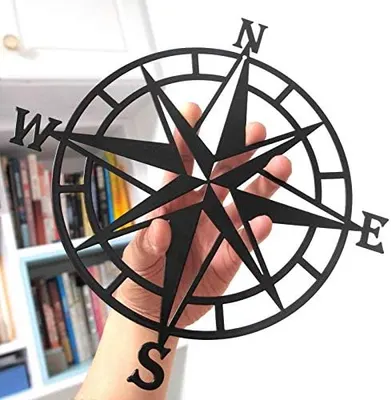
Nautical Compass Wall Decor, 14 in, Black
14 × 14 in
4.7 1,628 ratingscounted across all 6 versions of this piece

It is on the banner of this site four times over, it is the mark in every section heading you have scrolled past, and it is the only design in the catalog that comes in two sizes and six finishes. Here is why a shape borrowed from marine charts ended up as the thing this brand cuts best.
A compass rose on a chart marks the cardinal directions — north, east, south, west — with four long points, and the intercardinals between them with four shorter ones. That alternation is not decoration. It is how a navigator reads the card at a glance without counting: the long spikes are the ones that matter, the short ones are the halves. Cut the same figure out of steel and the alternation does a second job, because the eye needs unequal spokes to see a star rather than an octagon.
The mark used throughout this site is drawn to the same rule. Four long points, four short ones, and a waist between each pair so the whole figure is a single closed outline rather than eight separate spikes meeting in the middle.
Three reasons, and all of them are practical rather than aesthetic. It is radially symmetrical, so it hangs correctly on one hook and there is no wrong way up to get wrong. It has no thin unsupported limbs, so it survives shipping and a knock from a vacuum cleaner. And it is mostly holes, so it weighs almost nothing and the wall color behind it becomes part of the piece — which is why the same rose looks quiet on cream plaster and graphic on a dark feature wall.
The catalog carries the rose at 11 and 14 inches. The smaller one is a single-spot piece: over a door, in a hallway, on the narrow strip of wall beside a window. The larger one starts to work as the center of an arrangement, and it is the one to choose if it will hang over furniture rather than on its own. If you are unsure which, the planner will tell you — it has both in its list precisely because they are two different answers to two different walls.
A rose is unforgiving about level in a way that an irregular silhouette is not: a deer that hangs two degrees off looks like a deer, but a rose two degrees off looks broken. Hang it by its north point and check with a level rather than by eye, and if the wall has a picture rail or a door frame nearby, line the piece up with that rather than with the ceiling, which is rarely as straight as it looks.
Both diameters, every finish. All six sit under a single listing, so the rating and review count you see are shared between them rather than earned separately.
14 × 14 in
4.7 1,628 ratingscounted across all 6 versions of this piece
14 × 14 in
4.7 1,628 ratingscounted across all 6 versions of this piece
11 × 11 in
4.7 1,628 ratingscounted across all 6 versions of this piece
11 × 11 in
4.7 1,628 ratingscounted across all 6 versions of this piece
11 × 11 in
4.7 1,628 ratingscounted across all 6 versions of this piece
11 × 11 in
4.7 1,628 ratingscounted across all 6 versions of this piece
The roses share their section with the canoe paddle sets — the other symmetrical, easy-to-center thing in the catalog.